
Wind Over The Ground
Wind that blows over the ground creates a micro-pattern along the ground surface. As the wind passes over the ground, the wind speed is slowed due to friction with the ground surface. The type of vegetation and surface roughness will influence the degree of this effect. For the most part, you would not notice this effect.
What is important to understand, is that smaller particles and easily airborne particles will stay suspended in the air. Heavier particles will tend to flow across the ground until they are trapped by and object.

This can be seen by observing the materials that makes up the litter at different distances from the landfill operation.
Wind Over Hills
![]()
Hills cause a variety of effects on wind as it passes over. As the wind blows into the hill, it will tend to decrease in speed at the toe of the hill. This is because a high pressure zone occurs on the windward side of the hill. As the air mass moves up the hill slope, it will accelerate and will reach a maximum speed at the apex of the hill. A low pressure zone will occur on the downwind side of the hill and a reduced wind speed may be observed.![]()
![]()
![]()

Hills cause a variety of effects on wind as it passes over. As the wind blows into the hill, it will tend to decrease in speed at the toe of the hill. This is because a high pressure zone occurs on the windward side of the hill. As the air mass moves up the hill slope, it will accelerate and will reach a maximum speed at the apex of the hill. A low pressure zone will occur on the downwind side of the hill and a reduced wind speed may be observed.

Turbulent winds may also show on the upwind and downwind sides of the hill depending on wind speed and the shape of the hill.
In a landfill setting, these wind patters can be observed around stockpiles and fill areas. Dust can be observed drifting off the crest of a soil stockpile and litter can often be observed circulating in the turbulent winds on the downwind side of stockpiles and fill slopes.
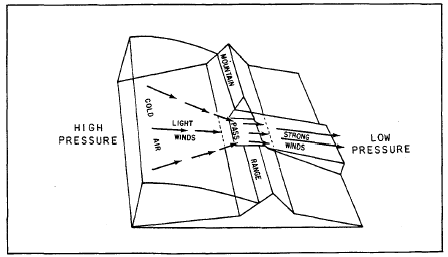
Wind Funneling
In a geographic valley setting, such as a mountain pass, wind that blows through the valley can accelerate. The valley acts like a venturi tube. As wind enters the valley it is compressed and increases in speed. When the wind exits the valley, the air pressure decreases, but the exiting wind is at a much higher speed than when it entered the valley. (look up Santa Anna Wind)
This same funneling effect can occur in a landfill setting where the wind is blowing parallel to an narrow open trench, or where it blows between two fill areas. The effect of this funneling may not be easily observed as it's effect may be minimal in most cases.

Topographic Exposure
The diagram at left shows an example topographic setting with perpendicular winds and parallel winds. A active fill area with the greatest exposure to strong winds are shown red, while low exposure is shown in green. A landfill operator should know where the highest topographical exposure area is at the landfill. It will not be the same for all landfills and all wind situations.
Observe the Wind
To develop an effective landfill litter management plan, the landfill manager should observe wind patterns on and around the landfill. Observe winds around all topographical features, both mounds and open excavations. Observe wind patters at different wind directions and speeds. Measure the winds. You can purchase hand held wind meters that you can use as you walk through the site. Record the different wind speeds.
Observe turbulent air patterns. You can often see plastic film circulating in turbulent air. You may also notice the wind speed recorded on your hand held wind meter is very erratic in highly turbulent air.
Observe how the wind effects your active working face and tip area. How is the litter wind blown, and where it goes to. Take photographs and record what you observe.


