| Wind | Km/Hr | Wind Blown Litter |
| Calm | Up to 10 | light film and paper |
| Light | 10 - 20 | crumpled dry paper, empty plastic bags |
| Moderate | 20 - 40 | light weight empty boxes, flat cardboard, paper products |
| Strong | 40 - 60 | corrugated cardboard boxes, sheets of Styrofoam, plastic containers |
| Gale | 60 - 90 | large boxes, sheets of ridge plastic, carpet, brush |
| Storm | 90 - 117 | construction materials (e.g. plywood sheets) |
| Hurricane | over 118 | almost anything that is not secured |
| Tornado (F1 - F5) | 105 - 322 | dangerous winds |
Understanding and managing litter at landfills is one of the most important daily duties of a landfill manager and landfill staff. Over time, posting on this blog will define what litter is, explain issues with litter control, and provide information that will feed ideas for managing landfill litter.
Showing posts with label wind speed. Show all posts
Saturday, October 22, 2011
How Strong is the Wind
Monday, July 4, 2011
Old Photos
I was going through some old computer photo files today. I came across some photographs I took on a cold winter day a few years ago at the Newell Regional Landfill. I thought I'd share these photos with you.
First thing you'll notice, it is cold and the landfill is snow covered. A good snowfall can make a landfill look pretty and clean. Snow is a real good at covering up litter. That is, until spring when it melts. That's why a spring clean up of landfills in our part of world is always scheduled in the operating plan.
The portable fences used at this site include a combination of litter catchment fences and wind screen fences. The fences are designed with a sloping face for better trapment of the litter. The wind screens shelter the working face to reduce the wind speed.
Friday, July 1, 2011
Wind Patterns at Landfills
At a landfill, you have to deal with winds of different speeds and strength, steady winds, gusting winds, and winds that come from different directions. The topography of your site affects the wind patterns at your site. Know and understanding these winds and wind patterns is key to understanding how to properly apply your litter controls.
![]()
Wind Over The Ground
Wind that blows over the ground creates a micro-pattern along the ground surface. As the wind passes over the ground, the wind speed is slowed due to friction with the ground surface. The type of vegetation and surface roughness will influence the degree of this effect. For the most part, you would not notice this effect.
What is important to understand, is that smaller particles and easily airborne particles will stay suspended in the air. Heavier particles will tend to flow across the ground until they are trapped by and object.
Wind Over The Ground
Wind that blows over the ground creates a micro-pattern along the ground surface. As the wind passes over the ground, the wind speed is slowed due to friction with the ground surface. The type of vegetation and surface roughness will influence the degree of this effect. For the most part, you would not notice this effect.
What is important to understand, is that smaller particles and easily airborne particles will stay suspended in the air. Heavier particles will tend to flow across the ground until they are trapped by and object.
This can be seen by observing the materials that makes up the litter at different distances from the landfill operation.
Wind Over Hills
Hills cause a variety of effects on wind as it passes over. As the wind blows into the hill, it will tend to decrease in speed at the toe of the hill. This is because a high pressure zone occurs on the windward side of the hill. As the air mass moves up the hill slope, it will accelerate and will reach a maximum speed at the apex of the hill. A low pressure zone will occur on the downwind side of the hill and a reduced wind speed may be observed.
Turbulent winds may also show on the upwind and downwind sides of the hill depending on wind speed and the shape of the hill.
In a landfill setting, these wind patters can be observed around stockpiles and fill areas. Dust can be observed drifting off the crest of a soil stockpile and litter can often be observed circulating in the turbulent winds on the downwind side of stockpiles and fill slopes.
Wind Funneling
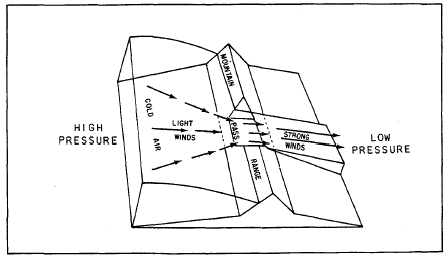
In a geographic valley setting, such as a mountain pass, wind that blows through the valley can accelerate. The valley acts like a venturi tube. As wind enters the valley it is compressed and increases in speed. When the wind exits the valley, the air pressure decreases, but the exiting wind is at a much higher speed than when it entered the valley. (look up Santa Anna Wind)
This same funneling effect can occur in a landfill setting where the wind is blowing parallel to an narrow open trench, or where it blows between two fill areas. The effect of this funneling may not be easily observed as it's effect may be minimal in most cases.
Topographic Exposure
The diagram at left shows an example topographic setting with perpendicular winds and parallel winds. A active fill area with the greatest exposure to strong winds are shown red, while low exposure is shown in green. A landfill operator should know where the highest topographical exposure area is at the landfill. It will not be the same for all landfills and all wind situations.
Observe the Wind
To develop an effective landfill litter management plan, the landfill manager should observe wind patterns on and around the landfill. Observe winds around all topographical features, both mounds and open excavations. Observe wind patters at different wind directions and speeds. Measure the winds. You can purchase hand held wind meters that you can use as you walk through the site. Record the different wind speeds.
Observe turbulent air patterns. You can often see plastic film circulating in turbulent air. You may also notice the wind speed recorded on your hand held wind meter is very erratic in highly turbulent air.
Observe how the wind effects your active working face and tip area. How is the litter wind blown, and where it goes to. Take photographs and record what you observe.
Sunday, June 26, 2011
Blowing in the Wind
It is quite intuitive to think that things that are lighter will be more prone to be wind blown than heavier objects. Items less likely to be blown about if they are heavy, such as a large metal object, or that have a high moisture content like food waste, or that have been compacted as in a compactor truck.
We also have to think about surface area as well. For example, a flat sheet of paper has a great surface area that easily becomes wind blown, yet if it is crumpled into a ball, it has a lower surface area and is less easily wind blown. We are all aware of the problem with plastic bags being blown about. Plastic bags are not only light and have a large surface area, but wind will blow into an open bag and carry them aloft.
Studies carried out in the late 70's for the Crowsnest Pincher Creek Regional Landfill showed how far a variety of objects could be blown at different wind speeds. The study was based on an object dropping about 1.5 M (as it would from an unloading collection vehicle), and that it would be blown away from the working face of the landfill.
Wind Speed Objects
10 - 25 km/hr Envelopes, dry paper
25 - 30 km/hr Empty plastic bags
30 - 50 km/hr Corrugated cardboard sheets, crumpled paper towels
50 - 60 km/hr Plastic strips, empty tissue boxes, tightly crumpled paper
60 - 90 km/hr Milk cartons, cardboard boxes
over 90 km/hr Metal cans
The energy in the wind is cubically proportional to the wind speedThe strength of the wind should never be under estimated. (E = v3). If wind speed is doubled, the energy increases by 8 times (2 x 2 x 2 = 8). Never under estimate the power in the wind. In strong winds, large objects, as shown here, can be blown out of the active landfill working face.
Subscribe to:
Comments (Atom)