Sunday, July 3, 2011

Landfill Impact Assessment

I was just reading Landfill Impact Assessment report.  The report went to great lengths evaluating dust, noise, landfill gas, and odours.  It included a brief discussion on litter impact.  The study effort included a great deal of work using dispersion models that used climate and wind data, topography and so on to determine what impact, if any, there would be on nearby receptors.   The authors took great efforts to determine waste quantities for the next 35 years, modelled landfill gas emissions, conducted traffic flow assessments, and measured odour emissions from the existing landfill


The Blowing Litter Impact Assessment reported the following information:


Distance from landfill perimeter
Finding
Impact category
0 - 500m
50% of escaping litter remains in this area
Medium
500 – 1000 m
Remaining 50% retained in this area
Low
Beyond 1000 m
Very little escapes beyond this distance
None


This information was said to have been taken from a 'previous report' by RWDI (2002).  I did an internet search in an attempt to find the original source of this information, but was unsuccessful (so far).  I could not determine if this referenced report was related to the existing landfill at this location.  


A second table that was referenced to RWDI (2002) is said to be a study conducted in wind tunnels on "threshold speeds for various categories of wind-blown litter".   Again, I tried to find the original source of this information, so I don't know how this study was done.  Did it replicate waste in a pile, or did it replicate waste dropping from an unloading vehicle?  I would assume that we would see different results between the two scenarios. 


Wind speed range
Litter description
Impact category
0 – 22 km/h
No blowing litter
None
22 – 33 km/h
Newsprint, tissue, paper towel, some light bond paper
Light
33 – 47 km/h
All the above plus plastic bags, small boxes, small cardboard tubes, paper bags, plastic sheets.
Moderate
Above 47 km/h
All the above plus extensive heavy bond paper
heavy


The authors of the report suggested that the average annual wind speed 10 metres above the ground is 8.6 km/hr, and that it would be about 2.3 km/hr at the 2 metre level.  The authors then concluded that for the majority of wind velocities at the landfill, blowing litter would not occur.  This conclusion was based on the following table.

Table L2.34 - Frequency of Occurrence of Blowing Litter with Wind Speed

Speed range
km/h

Annual frequency (%)

0 – 22

94.0

22 – 33

5.8

33 – 47

0.2

47+

<0.1


One can see if you connect all the dots using this information, you would come to a similar conclusion.    The authors further concluded that because most of the landfill operations will be below ground, this would further reduce wind-blown litter.   Recommendations suggested the litter mitigation should include, covering waste haul vehicles, daily cover of the working face, portable wind fences, improving vegetated lands buffering the landfill, educate the public about plastic bags, regular inspections and litter clean up. 


This evaluation is probably fairly typical of impact assessment studies. Litter issues usually don't get the same level of effort as other 'emissions' from landfills, even though litter is probably the most visible immission.  This may be because it is assumed that litter controls are very basic, such as cover, fencing, and cleaning up, that there's little need to do a complete evaluation.  Granted, because litter is visible and accessible, it is easier to respond to that a groundwater or gaseous emission impact.   I do think that landfill planners and engineers do need to give more attention to litter control and prevention.  They usually leave that up to the landfill manager and operators.   


I will admit, there may be more information available on specific litter controls in detailed operation plans.  At this time, I don't have that information. 


You can see the original report by going to the following link. 


https://muskoka.civicweb.net/Documents/DocumentDisplay.aspx?ID=5002

Friday, July 1, 2011

Wind Patterns at Landfills

At a landfill, you have to deal with winds of different speeds and strength, steady winds, gusting winds, and winds that come from different directions.   The topography of your site affects the wind patterns at your site.  Know and understanding these winds and wind patterns is key to understanding how to properly apply your litter controls. 


Wind Over The Ground

Wind that blows over the ground creates a micro-pattern along the ground surface.  As the wind passes over the ground, the wind speed is slowed due to friction with the ground surface.  The type of vegetation and surface roughness will influence the degree of this effect.  For the most part, you would not notice this effect.

What is important to understand, is that smaller particles and easily airborne particles will stay suspended in the air.  Heavier particles will tend to flow across the ground until they are trapped by and object.


This can be seen by observing the materials that makes up the litter at different distances from the landfill operation.    

Wind Over Hills

Hills cause a variety of effects on wind as it passes over.  As the wind blows into the hill, it will tend to decrease in speed at the toe of the hill.  This is because a high pressure zone occurs on the windward side of the hill.  As the air mass moves up the hill slope, it will accelerate and will reach a maximum speed at the apex of the hill.   A low pressure zone will occur on the downwind side of the hill and a reduced wind speed may be observed.  

Turbulent winds may also show on the upwind and downwind sides of the hill depending on wind speed and the shape of the hill.  

In a landfill setting, these wind patters can be observed around stockpiles and fill areas.   Dust can be observed drifting off the crest of a soil stockpile and litter can often be observed circulating in the turbulent winds on the downwind side of stockpiles and fill slopes.   


Wind Funneling

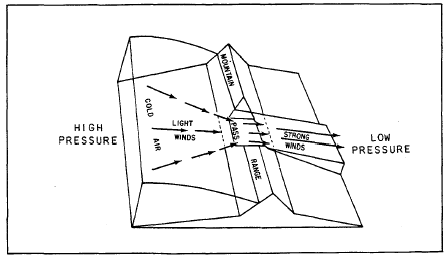
In a geographic valley setting,  such as a mountain pass, wind that blows through the valley can accelerate.   The valley acts like a venturi tube.  As wind enters the valley it is compressed and increases in speed.  When the wind exits the valley, the air pressure decreases, but the exiting wind is at a much higher speed than when it entered the valley.   (look up Santa Anna Wind)

This same funneling effect can occur in a landfill setting where the wind is blowing parallel to an narrow open trench, or where it blows between two fill areas.  The effect of this funneling may not be easily observed as it's effect may be minimal in most cases. 

Topographic Exposure

The diagram at left shows an example topographic setting with perpendicular winds and parallel winds.  A active fill area with the greatest exposure to strong winds are shown red, while low exposure is shown in green.   A landfill operator should know where the highest topographical exposure area is at the landfill.  It will not be the same for all landfills and all wind situations. 


Observe the Wind

To develop an effective landfill litter management plan, the landfill manager should observe wind patterns on and around the landfill.  Observe winds around all topographical features, both mounds and open excavations.   Observe wind patters at different wind directions and speeds.   Measure the winds.  You can purchase hand held wind meters that you can use as you walk through the site.  Record the different wind speeds. 

Observe turbulent air patterns.  You can often see plastic film circulating in turbulent air.  You may also notice the wind speed recorded on your hand held wind meter is very erratic in highly turbulent air. 

Observe how the wind effects your active working face and tip area.  How is the litter wind blown, and where it goes to.   Take photographs and record what you observe. 

Thursday, June 30, 2011

Litter around Bessborough landfill a problem, says resident

Litter around Bessborough landfill a problem, says resident

I found this story on the web.  You can read it and draw your own conclusions.  

Litter Controll at Lethbridge Waste & Recycling Centre

This landfill is located in southern Alberta and is in an area that is subjected to frequent windy conditions.  The City has the distinction of being the 2nd most windiest City in Canada.   Because of historical issues with litter problems at the landfill, the City and the site operators have implemented a comprehensive litter management program.  This is a brief summary of that program. 

Prevent Litter From Customer Vehicles

A secure load policy has been implemented and a surcharge is applied for all loads that are not enclosed, covered with a tarp, or firmly secured.  The surcharge rate is $20/load for loads under 1 tonne, or $40/load for loads over 1 tonne.  

Haulers may also be subject to fines for transporting unsecured loads and causing litter along public highways.

Monitoring & Litter Collection

Regular monitoring is conducted and the site operators retrieve litter along roads, ditches, and nearby irrigation canals. Depending on the road, this retrieval occurs daily to weekly. 

Fence lines around the landfill are monitored and litter is retrieved to keep the site clean. 

Litter is collected from private property adjacent to the landfill site and along road ways with access permission from the land owner.  

Illegal Dumping

To prevent illegal dumping, the City offers a large item service to residents, and provides a free Saturday disposal program. The City conducts regular monitoring for illegal dumping and works with enforcement agencies. 

Litter Controls

A combination of techniques are used at the landfill to prevent litter from occurring and to prevent litter from escaping.  

Portable wind screen fences to shelter the working face and catch fences are used downwind to catch any blowing litter.  The working face is kept as small as possible to minimize exposure of waste to wind.  

An 8 meter tall 'primary' entrapment fence is placed at the edge of the landfill operations, and a 12 meter tall 'secondary' entrapment fence is placed downwind (east side) of the landfill. 

The landfill operations are closed when winds exceed limits set out under the Environmental Approval.  Walking floor transfer trailers are prohibited from unloading when wind gust exceed 60 km/hr, and all loads are prohibited when wind gusts exceed 70 km/hr. 


Transfer Station & Baler

To address the issues with collection systems because the landfill is shut down high wind conditions, the City has constructed a transfer station with a baler.  The waste bales are 'wrapped' and when placed at the landfill, they are not a source of blowing litter.  


Other Technologies

The City and the site operators continue to investigate other technologies to add to the existing litter controls.  For example, a trial for application of a spray on mulch alternative daily cover was used.  

Wednesday, June 29, 2011

Good Fences Make Good Neighbours

"When it comes to controlling litter, good fences make good neighbours"   Neil Bolton is a consultant that specializes in landfill operations.  He also writes for MSW Management.   This is a link to an article he wrote and that was published in the October 2004 issue. 

http://www.mswmanagement.com/september-october-2004/controlling-litter-good.aspx


Wind Patrol - Litter Fence

In this article, Mr. Bolton talks about portable fences and the importance of placing them to be effective.  He also talks about using wind break fencing materials to reduce wind speed and turbulence.  The article discusses litter retrieval and how to deploy staff assigned to picking litter. 


Wind Patrol - Wind Break


In future posts, we'll show wind patterns that affect landfill operations, and we'll show the use of litter catch fences and wind breaks.   Mr. Bolton's article is a good lead into these topics. 


Tuesday, June 28, 2011

Landfill Litter Management

Here I'll summarize some basic techniques for managing, or controlling, litter at landfills.

1.   Develop a Litter Management Plan

Prepare a written plan that describes the litter management programs for your landfill.  This plan should outline bylaws or ordinances and how enforcement is done.  The plan should include policies and procedures for managing improperly contained waste loads.  It should include procedures for directing customers on-site and describe operating procedures for site litter controls.   With this plan, you should identify how you will monitor the effectiveness of the litter controls and you should include a practical response plan for litter clean-up. 

2.   Present a professional image.  

If you maintain a pleasing appearance at your landfill, you gain a greater degree of cooperation of your customers.  They will appreciate the effort to keep a site clean and are far more likely to take more care in how they transport their own loads are are far more likely to pay attention to site rules and site staff directions.  This can help your operation in more ways that just litter control, but it is an important piece of a litter management program.


3.   Cover

Cover includes cover of waste transporting vehicles and cover of waste disposed in the landfill.  Waste loads should be secured, tarped, or enclosed to prevent litter along roads leading to the landfill and along the landfill site roads.  This generally requires cooperation of legal enforcement agencies to be effective. 

Waste that is deposited at the landfill should be covered within practical reason to minimize exposure of the waste to wind. 

4.  Shelter to Prevent Wind-Blown Litter

An active working face that is sheltered from wind will minimize the amount of wind blown litter.   Shelter can be provided using natural wind breaks such as tree cover and sometimes topographical features.   Using portable wind-breaks placed on the upwind side of an active working face has also proven to be effective in reducing the speed of wind, thus reducing the amount of blowing litter. 


5.  Catch Litter

Most landfills use a variety of litter 'catch' fences to trap litter so that it doesn't escape the landfill.  This can include portable fences placed around the active working face,  temporary intermediate fencing placed through the landfill property, and perimeter fences at the site property lines.  


6.   Retrieve Litter

With effective litter control fences and operation procedures, there will be times when litter still escapes the active landfill area, or the landfill property.   The litter program MUST include a retrieval or clean up program in a timely way so that any fugitive litter does not collect for any unacceptable length of time.

Monday, June 27, 2011

Exposed to Wind

How much waste that is exposed to the wind can be directly related to the amount of wind blown litter you will have.  A large working face that is un-sheltered will certainly result in a high amount of wind blown litter.   Keeping an active working face as small as possible, or practical, is an important part of litter control.  In high wind conditions, it may be necessary to reduce the size of the exposed face, even if it means that inbound vehicles need to line up in a cue and await their turn. 


Sheltering the working face by taking advantage of surrounding topography may be effective in some circumstances and not so much in others.  More on this later when we discuss wind patterns and turbulence.   Using artificial wind breaks can provide some reduction in wind speed, and this will be discussed in a later post.   In this photo, this landfill is using a combination of fencing systems to provide shelter and to catch litter.  But most importantly, the working face is kept as small as possible to reduce the amount of waste exposed to the wind. 

Compacted Waste


Litter will be more easily wind blown when it is not compacted than if it is compacted.  Waste collection vehicles with compacted loads will have less litter wind blown as they unload than will the un-compacted loads.  Waste that is compacted on the working face is less likely to become wind blown than waste left in piles and exposed to the wind.    It should be remembered though that by pushing waste in windy conditions may actually add to the wind blown litter problem. 

It is important that the equipment operator understands that when spreading waste piles, the waste should be  pushed along the fill surface and not carried and dropped.  

Soil Cover

Covering the working face with soil will eliminate exposed waste and it cannot be pick up in the wind.    The equipment operator should advance the soil cover over the top bench of the daily cell to minimize exposure during the day.  Soil cover or an alternative cover is normally placed over the face at the end of a day's operation.  In some high wind conditions, the operator may need to apply a 'sprinkling' of soil cover over the working face during the day's operation to help control blowing litter. 


Sunday, June 26, 2011

Blowing in the Wind

It is quite intuitive to think that things that are lighter will be more prone to be wind blown than heavier objects.  Items less likely to be blown about if they are heavy, such as a large metal object, or that have a high moisture content like food waste, or  that have been compacted as in a compactor truck. 

We also have to think about surface area as well.  For example, a flat sheet of paper has a great surface area that easily becomes wind blown, yet if it is crumpled into a ball, it has a lower surface area and is less easily wind blown.   We are all aware of the problem with plastic bags being blown about.  Plastic bags are not only light and have a large surface area, but wind will blow into an open bag and carry them aloft.  


Studies carried out in the late 70's for the Crowsnest Pincher Creek Regional Landfill showed how far a variety of objects could be blown at different wind speeds.  The study was based on an object dropping about 1.5 M (as it would from an unloading collection vehicle), and that it would be blown away from the working face of the landfill.  


Wind Speed                    Objects
10 - 25 km/hr                    Envelopes, dry paper
25 - 30 km/hr                    Empty plastic bags
30 - 50 km/hr                    Corrugated cardboard sheets, crumpled paper towels
50 - 60 km/hr                    Plastic strips, empty tissue boxes, tightly crumpled paper
60 - 90 km/hr                    Milk cartons, cardboard boxes
over 90 km/hr                   Metal cans


The energy in the wind is cubically proportional to the wind speedThe strength of the wind should never be under estimated.  (E = v3).  If wind speed is doubled, the energy increases by 8 times (2 x 2 x 2 = 8).  Never under estimate the power in the wind.  In strong winds, large objects, as shown here, can be blown out of the active landfill working face.   

Lasting Trash


Different littered materials will remain in the natural environment for a varying length of time depending on how quickly they degrade, either biologically, chemically, or because of sunlight.   This kind of information can be easily found by doing a web search.  The Virginia Department of Environmental Quality published this information on it's web page. 

Material                                           Time to Degrade
Piece of Paper                                    2 to 4 weeks
Orange and Banana peels                    2 to 5 weeks
Cotton Rags                                       1 to 5 months
Disposable diapers                             10 to 20 years
Plastic bags                                        10 to 20 years
Aluminum cans                                   80 to 100 years
Glass                                                  indefinitely

What is Litter

Litter was defined in the Handbook of Solid Waste Management (D.G Wilson, 1977) as:

"Litter Comprises of those solid wastes found free on the ground due to either intentional or unintentional careless disposal practices"

Webster's Dictionary defines in more simply as:

"trash, wastepaper, or garbage lying scattered about"

Regardless of which definition you prefer, litter is an undesirable consequence of human existence.  Litter at landfills is either because of waste spilled off of hauling vehicles, indiscriminate dumping of waste loads, carelessness, or it is wind blown from the landfill operations. 

Litter is comprised of both large and small items.  Large items include, but is not limited to:  cans, boxes, glass bottles and jars, paper, cardboard, plastic bags and containers, construction debris, appliances, furniture, tires, vehicle, and equipment parts.  Small items might include these and other materials:  metal pieces and nails, bottle caps, cigarette butts, glass pieces, paper pieces, and plastic pieces. 

Example Landfill with Litter Issues


This landfill is located on the Canadian Prairies in an area that is un-sheltered and is exposed to windy conditions that are typical of the southern portion of the Canadian Prairie Provinces.   

At this point in time, the operators maintained a large open working face that was about 25 to 30 feet high.  Waste was unloaded from self-haul customers at the bottom (toe) of the working face, and commercial customers unloaded at the top.   

Vehicles unloading at the bottom of the face were somewhat sheltered and litter catchment fences were around the tipping area, but were not well positioned for best protection.

The commercial vehicles unloading at the top were exposed to high winds and there was no litter control fencing provided for shelter or litter catchment. 


To add to the litter issues, effective bylaw and bylaw enforcement was lacking.  Loads on inbound vehicles were often unsecured.  This led to litter along roads leading to the site and contributed litter issues at the landfill. 


The operators were provided with well designed portable litter catchment fences.  The fences were not effectively used around the working face.  Fences were placed around the lower tipping area, but they were not well positioned to closed the gaps between fence sections.    These fences were not effective in catching blowing litter off the working face, simply because of the height of the working face.   The tipping area at the top of the face, which was the most exposed to the wind,  had no litter fencing available.  

THE RESULTS


Recommendations

The recommendations for litter management at this site included:

-  minimize and control the size of the working face
-  increase the amount of portable litter catch fences
-  place portable fences where they will be effective and close gaps
-  add portable wind-break fences to shelter exposed tipping areas
-  establish effective controls for un-secured loads
-  implement a litter retrieval program

Sunday, June 19, 2011

Perception = Reality

This site has an image problem.  if un-managed, litter is probably the first thing that a customer or a neighbour sees at a landfill.   Litter leaves a negative image in one's mind, and if not addressed properly, it can lead to distrust in all aspects of a landfill operation and management.  
A well maintained site with an effective litter management program leaves a positive image.  Customers using the site tend to be more cooperative, simply because if you show that you care, they will care too.   Neighbours to the site will have more trust in the site owners and operators, and there are cases when neighbours to a well run landfill have spoken out in support.   Hard to believe, but it happens. 


 Issues with Landfill Litter:
  • environmental impacts
  • impact on private property
  • leads to distrust
  • leads to loss of credibility
  • Regulatory non-compliance


What are the environmental impacts?

  • blight on the land
  • odours
  • surface water impacts
  • interferes with farm equipment
  • can be harmful to farm animals and wildlife
  • can impact property value


Owners and operators of landfills with litter problems face several liability issues:

  • financial cost of clean up & fines
  • legal issues with regulatory action and neighbour legal suits
  • loss of political favour
  • loss of community trust
  • effect on business relationships


Perception = Reality:     If your neighbours perceive that you have a litter issue at your landfill,  then the reality is that you have a litter problem that needs to be addressed. 

Evolution of Landfills in the 20th Century

You might think this is an odd title for this blog entry because it refers to the 20th Century.    We could go back to the beginning of time and talk about a time when the human population was nomadic and disposal of waste was as natural as it is in the animal population.  I wanted to focus on modern history rather than ancient history for the evolution of landfills. 

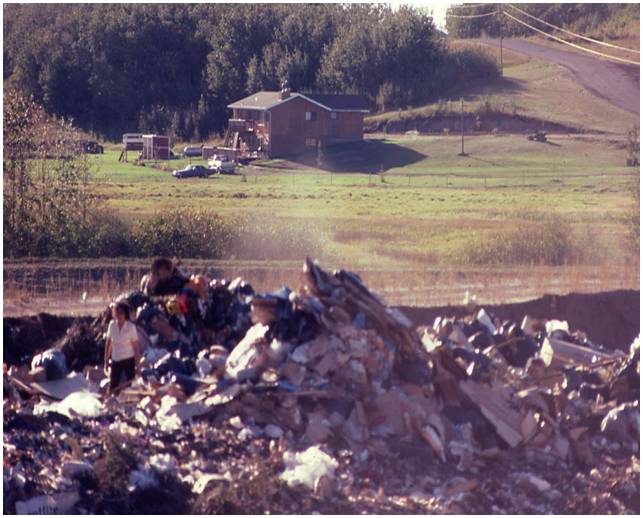
 This photograph shows a typical municipal dump site that existed in Western Canada well into the 1980's.  At one time, the Health Departments even encouraged burning of wastes as it was thought to be more sanitary.   Burning, of course, created its own health issues and environmental problems.  In the early part of the 20th century, our waste products mostly contained wood products, metals, food wastes, some paper products and so on.  Plastics started to become more prominent in the 1950's and by the 1980's, our waste were a much more complex mix that included plastics, chemicals, and other commercial products.  

Burning of waste in an open trench is incomplete in comparison to incineration in a highly technical waste to energy facility.  Incomplete burning emits toxic smoke that includes dioxins and furans, and can impact the health of the population around the site.  

During that time, the most common complaints about the 'open dumps' had to do with burning.  Residents complaint of the smoke and the smell. 


 Because open burning became a problem issue, Health & Environmental agencies then began to pressure municipalities to stop burning.  The pressure came through education and by enforcement actions in some cases.  

The consequences of not burning without changing the fundamental way in which we operated the old dump sites was often ignored.   With the uncovered waste piling up in the open trenches, the rotting waste caused odour, insect, and animal nuisances.  Leachate issues were still ignored.  Disposal trenches filled rapidly because waste was not being compacted.    Litter issues became a much larger issue, and complaints about uncontrolled blowing litter became the top public complaint issue. 


Fortunately, Health and Environmental agencies and municipalities took action to develop engineered landfills and developed proper landfill operating plans and procedures.  The landfills were not only designed better, but they were also equipped better.  Landfill operators were better trained  and their job status gained respectability. 


Still, even with these improvements made over the past several years in landfill design and operation, litter issues remained in many cases.  

Managing litter issues at a landfill involves a variety of control techniques that includes, covered loads on hauling vehicles,  waste handling and compaction,  litter control fences, wind shelter, and effective litter retrieval programs.  Some landfills also have limits on waste receipts in high wind conditions. 

In future blog entries, I will explain many of these techniques. 

Monday, April 11, 2011

Understanding Global Winds

For a landfill operator to become insightful towards effective litter control, he needs to pay attention to and understand wind patterns around the landfill.  But, we'll start with explaining a few basics about global wind patterns.
The wind patterns around the earth has something to do with the coriolis effect, which has to do with the rotation of the earth. In most of North America, global winds are generally blowing from west to east, and most of our weather systems move west to east.  Think of which direction most of our summer storms come from.
In tropical climates, the trade winds are generally blowing towards the east.   Weather systems in the tropics tend to move from east to west.  Think of the direction that hurricanes and cyclones move around the globe.  


Regional wind patterns are influenced by high and low pressure zones.  The air moves in circular patterns around these pressure areas.   Winds will blow clockwise around high pressure zones, and counter clockwise around low pressure zones.   The direction of the wind where you are depends on where you sit within these high and low pressure areas. 
Understanding these basic wind patterns can be useful in planning the layout of a landfill development with consideration of prevailing winds, and by paying attention to local and regional weather systems, the operator can adjust daily operations and litter controls according to weather forecasts. 
Much of this information can be obtained from local weather stations.  In Canada, you can go online and log on to Environment Canada and get up to date weather information. 
In forthcoming posts, I will discuss regional wind patterns that are influenced by geography. 

Friday, April 8, 2011

Do you have a landfill litter problem?

Neal Bolton of Blueridge Services Inc. wrote a book "Landfill Operator's Handbook" which is probably the most useful book to a landfill operator that you'll find.  He also writes numerous article on landfill operation and safety.  In his writings, he often talks about litter control.  If you don't have his book, you should check it out.  Look up the web page for Blueridge Services Inc. 

In his writings, Mr. Bolton makes the statement that "all landfills have litter, but not all landfills have a litter problem".   Based on this statement, in my courses that I teach on this topic, I ask the following questions:

-  Do your neighbours complain about litter at your landfill?
-  Do the regulators comment on litter problems when they do inspections
-  Do you think you have a litter problem. 

If you can answer No to these 3 questions, then you might not have a litter problem. Of course, if the answer is Yes, then you have a problem that you need to address. 

I had this discussion today with a contractor of one of our operations.  We were out doing an inspection around the site and now that the snow has almost melted away, the ugly side of litter that has collected over the winter is showing its ugly head.  As we talked about getting after the spring clean up, I mentioned that my belief is litter on your site reflects your image.  If you don't tackle the litter problem, your image will certainly be negative.  When a site is kept clean, you display a positive and professional image. 

In my former life as a regulator, if I went onto a site that was clean, well organized, and had excellent litter control, my inspections were less likely to get too intrusive.  You might say I didn't look under the carpet to see what was hidden.   On the other hand, if I went onto a site that was disorganized and litter was abound, I would start looking deeper into the operation to see what else was wrong.  This was really because of a natural human reaction.  If everything visually looks right, there is an instant level of trust.  If it doesn't look right, there is no trust.  

The same can be said for the public reaction.  A clean site will gain trust, and messy site will lose trust.   A few years ago, well maybe more than a few (I'm getting to be an 'old guy" in this business), I got involved in a landfill with a severe public image problem.  The neighbours had lost complete trust in the landfill owner, the landfill operators, and the government regulators.   This one landfill consumed almost 80% of my time in that one year.  The regulators began looking into every detail including design, operating plans, groundwater,  waste acceptance, site controls, and of course litter.   This landfill had an ongoing litter problem that the site operators ignored even after their image was severely damaged.  The landfill operator, owner, regulators and public ended up in a lengthy legal hearing that only the lawyers seem to come out ahead, the municipality owners lost political credibility, the regulators lost credibility, and the landfill contractor eventually lost the operating contract.   If the litter problem had been properly dealt with by all parties in the first place , I don't believe this long drawn out nightmare would have happened. 


This is only one example of where lack of litter controls at a landfill have caused public distrust and loss of credibility by the owners and operators of a landfill.  I have seen too many examples over my career.  

There is an old saying "Perception is Reality".   You can apply this to your landfill.  If the public perceives that you aren't managing the litter at the landfill, chances are that your aren't. 

Stay tuned!  In future posts, I'll be talking about various techniques for litter control.